🔻Bazarkurdistan:
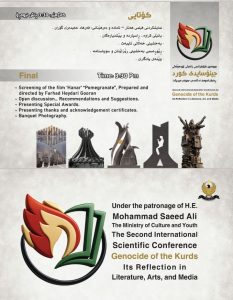
The second international scholarly conference dedicated to the Kurdish genocide (Anfal) was held on August 26–27 in the city of Sulaymaniyah, in collaboration with the Ministry of Culture and Youth of the Kurdistan Region. Researchers, university professors, and artists participated in this conference.
The Anfal operation, carried out in 1988 by the forces of Iraq’s Ba’athist regime under the direct orders of Saddam Hussein, resulted in the mass killing of more than 180,000 Iraqi Kurds (according to some sources, more than 200,000). Over a seven-month period, from February to September 1988, in the provinces of Kirkuk, Diyala, Nineveh, and Salah al-Din alone, more than 4,200 villages were completely destroyed and 182,000 people were killed by the Iraqi army, intelligence, and security forces.
The Anfal project was also carried out in several towns and villages in Iranian Kurdistan, such as Somar, Baneh, Sardasht, Nasardira, Zarda, and Baveyagar in the Dalahu region.
Kurdish author Farhaad Heidari Guraan, in his novel Nafas-Tangi (Shortness of Breath), addresses the chemical bombardment of Zarda and Sardasht. This novel, acclaimed by critics as a postmodern and innovative work, was nominated for the Mehregan Adab Award — Iran’s most prestigious literary prize — in 2008. The third section of the novel, titled “Koche Shamar”, was one of the winers the Mehregan Award in 2020.
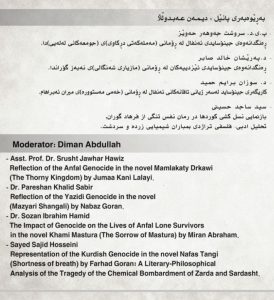
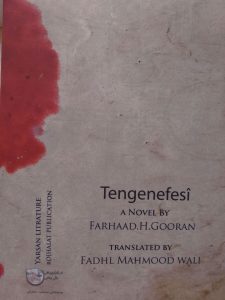
At the second genocide conference, Sajed Hosseini will discuss how the Kurdish genocide is represented in Farhaad Heidari Guraan’s novel Nafas-Tangi. This novel was translated into Sorani Kurdish in 2016 by Fazel Mahmoud Wali and published in Erbil by Mali Wafayi.
The Representation of Kurdish Genocide in Farhaad H.Guraan’s Nafas Tangi:
A Literary-Philosophical Analysis of the Tragic Chemical Bombing of Zardeh and Sardasht
Sajed Hosseini
MA in English Language and Literature,
Executive Manager of Critical Literary Studies Journal
sajed.hosseiny@gmail.com
Abstract:
This article explores the representation of the Kurdish genocide in Farhaad H. Guran’s novel Nafas Tangi. Inspired by the real events of the chemical bombings of Zardeh and Sardasht—events widely recognized as acts of genocide against the Kurds—the novel offers a multilayered and complex narrative of the profound impacts these tragedies have had on both individual and collective identity. Taking advantage of postmodern writing techniques and web-writing, Goran immerses the reader in a narrative where the boundaries between memory, history, and trauma-induced delirium are intricately blurred. In the current study, the concepts and theories of philosophers such as Hannah Arendt, focusing on the “banality of evil,” Giorgio Agamben’s theory of “bare life,” Michel Foucault’s analyses of “power and the body,” and Jeffrey C. Alexander’s notions of “cultural trauma” are employed to scrutinize the psychological and social consequences of genocide on the characters and social structures portrayed in the novel. Nafas Tangi is considered not only as a significant literary work but also as a reflection of the historical memory and collective wounds of the Kurdish people, illustrating how literature can serve as a powerful tool for the representation and healing of social traumas.Keywords:
Kurdish Genocide, Chemical Bombing, Banality of Evil, Bare Life, Power and The Body, Cultural Trauma